Syringes & needles

Insulin Syringes

Capacity, calibration & needle specifications

Insulin syringes have markings calibrated for a specific insulin concentration. Capacity, scale increments and needle dimensions distinguish the complete device, helping you identify the supplies specified in your care plan.
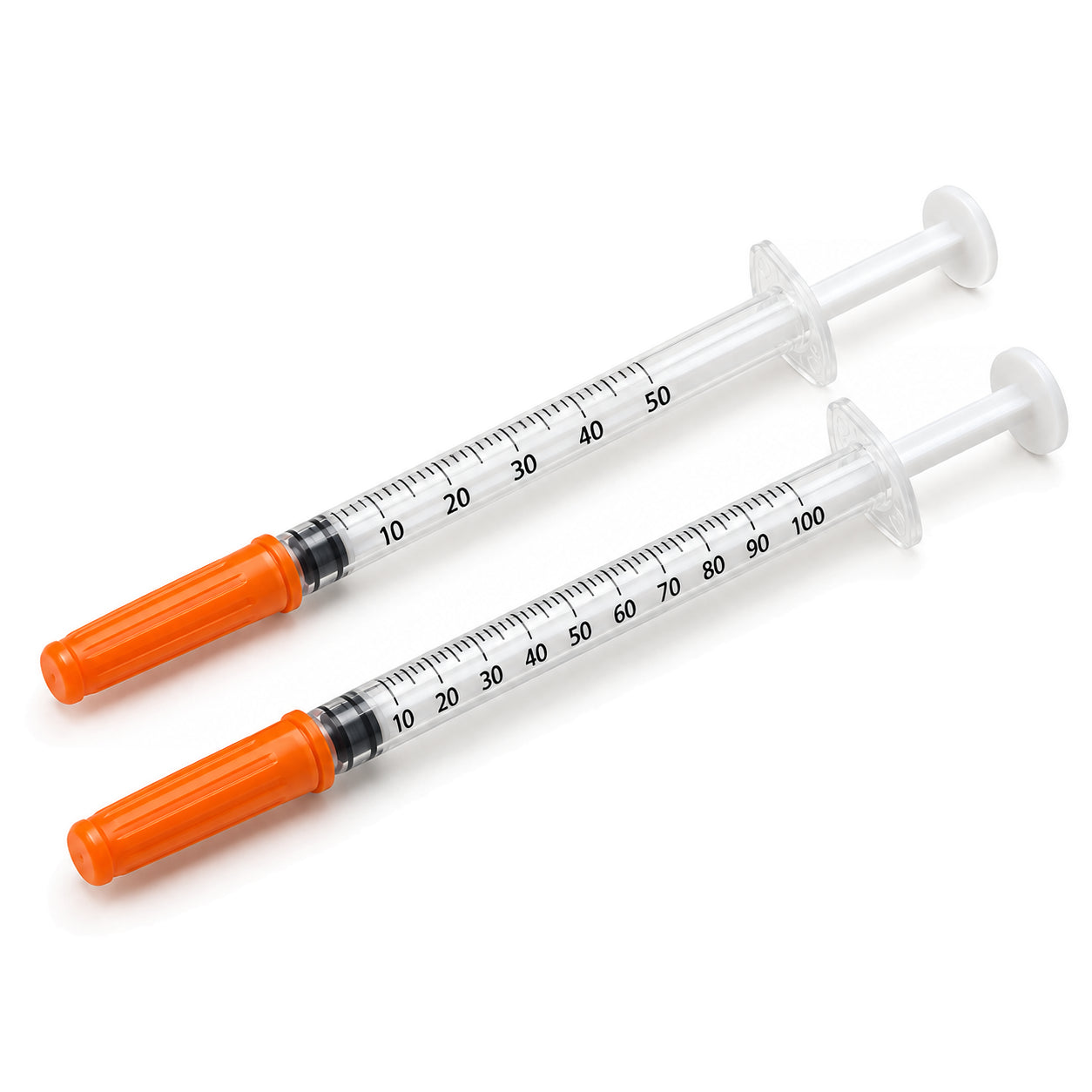
  • Capacity
  • Scale markings
  • Needle dimensions
Join the waitlist

Get updates on our telehealth launch.

Understanding the device

Understand the syringe you use.

A familiar-looking syringe can still have a different scale or needle. Start with the three details below, then check the complete manufacturer reference with your care team.

Three details to check

CapacityThe volume the barrel holds
CalibrationThe insulin concentration and scale
NeedleLength and gauge
Read these together on the exact package or manufacturer reference. [1]

Capacity is not the prescribed amount

Manufacturer examples include 0.3 mL, 0.5 mL and 1 mL insulin syringes. Capacity describes the barrel; the scale describes its marked increments. Some 0.3 mL models have half-unit markings. Your care instructions determine the appropriate device and amount. [1]

The calibration must match the insulin

U-100 and U-500 identify different insulin calibrations. Embecta provides a dedicated U-500 syringe for U-500 insulin. Do not substitute based on barrel size or appearance; confirm the medicine and syringe together with your clinician or pharmacist. [5] [6]

Check both needle measurements

Length and gauge are separate specifications. Embecta lists, for example, 6 mm × 31G and 12.7 mm × 30G insulin syringe needles. These examples explain the labeling, not which needle you should use. Keep both measurements when asking about a replacement. [5]

Specifications & device distinctions

Specifications

Understand the specifications.

Use the exact package reference to compare the complete device. [1] [5]

Capacity
Barrel volume in mL
Calibration
The specified insulin concentration, such as U-100
Scale increments
Whole-unit or half-unit markings, as labeled
Needle
Length and gauge
Product reference
The manufacturer’s exact model or package identifier

The reference connects these specifications to a particular product. [1] [5]

Device distinctions

A syringe and a pen needle are different devices.

An insulin syringe is used with insulin supplied in a vial. Pen needles belong to a separate device category for insulin pens. The delivery device matters as well as the medicine. [1] [6]

General-purpose syringes marked in milliliters are another category. Do not treat their markings as interchangeable with an insulin syringe’s scale. Ask your care team to resolve any difference before using a replacement.

Explore general-purpose syringes

See how the supplies fit together.

Compare the two syringe families, then explore the other supplies that may be part of a prescribed care plan.

How it works

Supplies, considered alongside your care.

We’re building a telehealth service that connects clinical evaluation, prescription review and the supplies a care plan requires.

  1. Review your care needs

    Discuss your medication, its instructions and any supplies you already use during clinical evaluation.

  2. Confirm the device

    Review the required calibration, capacity and needle specifications with the care team.

  3. Plan fulfillment

    Clarify prescription requirements and available delivery options after the required checks.

Already have a prescription? A separate pathway for prescription review and associated supply needs is also planned.

More about our planned service

Use & handling

Use once. Dispose of safely.

  • Use a new device. Insulin syringes are intended for single use. [6]
  • Never share. Changing the needle does not make a used syringe safe for another person. [3]
  • Use a sharps container. Place used needles and syringes directly into an FDA-cleared container, then follow its fill limit and your community’s disposal guidance. [4]

Follow the device labeling and your care team’s instructions. This page does not select a syringe, convert a dose into syringe markings or teach injection technique.

Common questions

Your questions, answered.

Are U-100 and U-500 insulin syringes interchangeable?

No. Their scales are intended for different insulin concentrations. Embecta identifies a dedicated U-500 syringe for U-500 insulin. Confirm the exact insulin and syringe with your pharmacist before use. [5] [6]

What does a half-unit scale mean?

It means the labeled scale includes half-unit increments. This feature is available on certain models; it is not implied by the barrel capacity alone. [1] [6]

How do I check a replacement package?

Compare the manufacturer reference, calibration, capacity, scale increments and needle dimensions. Embecta’s packaging guide links older BD references to newer embecta references; a familiar logo alone is not the complete specification. [1] [5]

Can I reuse an insulin syringe?

No. The manufacturer recommends single use. Put the used device directly into a sharps container rather than keeping it for another injection. [6] [4]

Original information

Sources & further reading.

  1. embecta: Product reference and packaging guide (opens a new tab)
  2. BD: Hypodermic product catalog (opens a new tab)
  3. CDC: Preventing Unsafe Injection Practices (opens a new tab)
  4. FDA: Sharps Disposal Containers (opens a new tab)
  5. embecta: U-100 syringe specifications and product references (opens a new tab)
  6. embecta: Insulin syringe capacities, scales and single-use guidance (opens a new tab)

Sources checked October 19, 2026. Manufacturer references explain device specifications. Follow your care team’s individual instructions.