Sterile diluent
Bacteriostatic Water℞
for Injection, USP
Bacteriostatic water is sterile water with an added preservative, used to dissolve or dilute compatible injectable medications. Hospira’s 30 mL multi-dose vial contains 0.9% benzyl alcohol to help limit bacterial growth and is designed for repeated withdrawals.
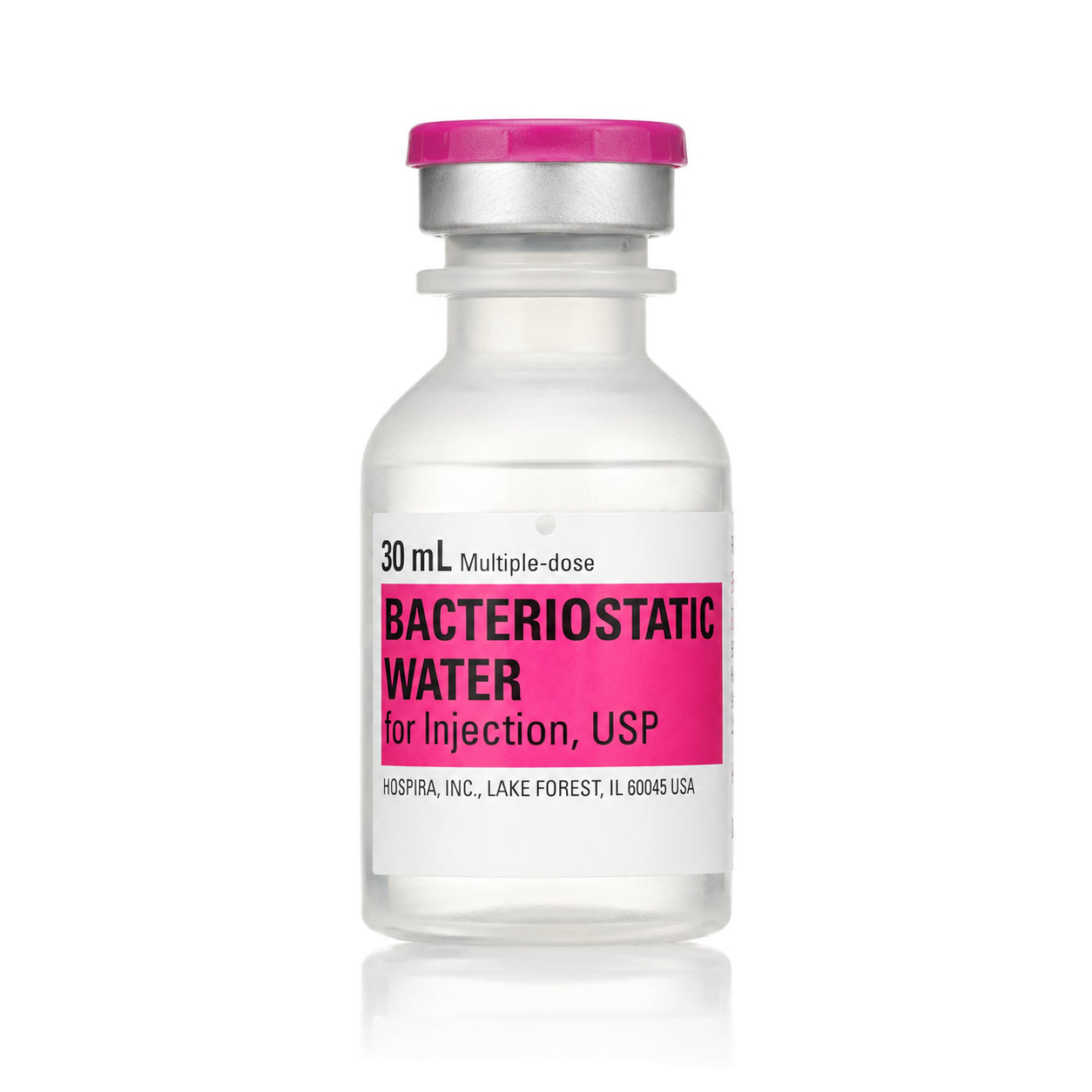
- 0.9% benzyl alcohol
- Multi-dose vial
- Prescription only
Hospira / Pfizer
Multiple-dose plastic vial
Get updates on our telehealth launch.
About this diluent
The difference is in the formulation.
Preparing an injectable medicine starts with the right diluent. The formulation and container matter because they affect compatibility, repeated access and what happens after the vial is opened.
Why some medicines need a diluent
A diluent is the liquid used to prepare a medication for administration. Some injectable medicines come as a powder that must be dissolved; this is called reconstitution. Others need dilution to reach the concentration specified in their prescribing instructions. Bacteriostatic water can perform either role when the medicine’s manufacturer identifies it as a compatible diluent.
The choice is specific to the medicine. Sterile water, bacteriostatic water and saline are not automatically interchangeable, and bacteriostatic water is intended for medication preparation—not injection on its own. [1]
What the preservative changes
“Bacteriostatic” refers to limiting bacterial growth. The featured 30 mL Hospira vial contains 0.9% benzyl alcohol for this purpose. The preservative does not protect against viruses or make a vial immune to contamination. Aseptic technique remains essential every time the vial is accessed.
That is a key distinction from Hospira’s preservative-free Sterile Water for Injection, which contains no antimicrobial agent and is supplied in single-dose containers. Leftover contents from a single-dose container should not be saved for another use, even for the same person. The medication’s requirements determine which formulation is appropriate. [1] [4] [5]
What “multi-dose” means for the vial
The multi-dose format permits repeated withdrawals from the same vial. The 30 mL on the label describes how much liquid the vial contains—not a medication dose or the amount to use for a particular preparation. That amount is determined by the medicine’s prescribing instructions.
Once punctured, a multi-dose vial has an opened-vial use period. CDC recommends dating it and discarding it within 28 days unless its manufacturer specifies a different period, never beyond the original expiration date. A prepared medication has separate storage and stability requirements: the diluent’s opened-vial period does not establish how long the mixed medicine can be kept. [1] [4]
Product details & packaging
How it works
The care experience we’re building.
Our planned service connects clinician evaluation, prescription review and pharmacy delivery in one clear path.
Clinical evaluation
An online clinician review of your medications and care needs.
Prescription, when appropriate
A clinician determines whether a prescription is suitable for your treatment.
Pharmacy delivery
Pharmacy fulfillment and delivery after the required clinical and prescription checks, subject to eligibility and availability.
Already have a prescription? Our planned service also includes a prescription-verification pathway.
More about our planned serviceUse & handling
Important information
- Not for injection on its own. Intravenous injection of the water alone can damage red blood cells.
- Not for newborns. This product must not be used in neonates because of benzyl-alcohol toxicity.
- Not for fluid replacement or spinal procedures. Its labeling excludes fluid replacement and epidural or spinal anesthesia procedures.
These are key restrictions from the manufacturer’s prescribing information. [1] Your clinician or pharmacist should confirm the diluent required for your medicine and explain its preparation and handling.
Read the full prescribing information (opens a new tab)