01 / What changes
What the preservative changes.
Read the ingredient statement and the container designation together. They answer different questions: what is inside the vial, and how that particular container is intended to be used.
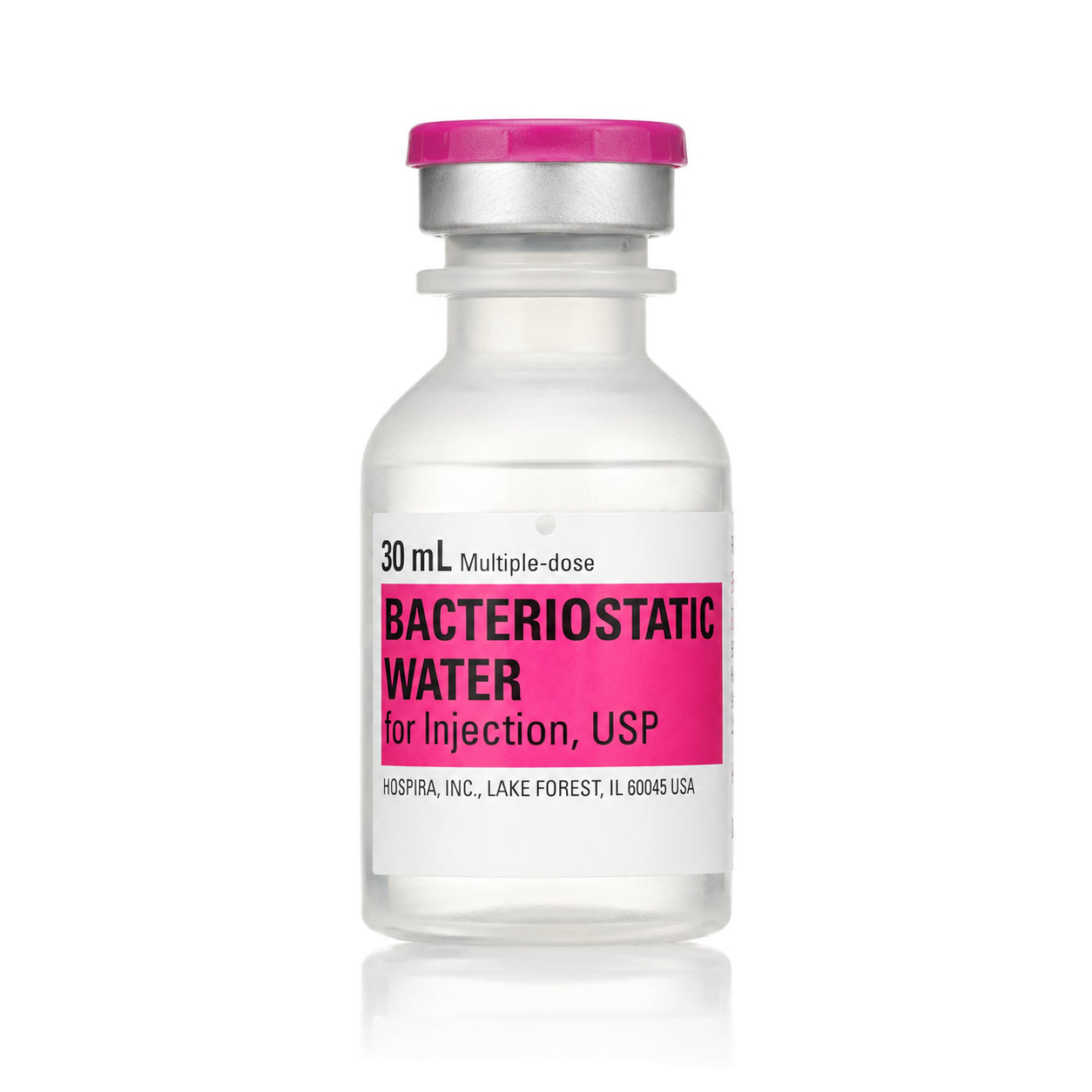
With a preservative
Bacteriostatic Water
for Injection, USP
- Shown
- 30 mL plastic vial
- Preservative
- 0.9% benzyl alcohol
- Container
- Multiple-dose
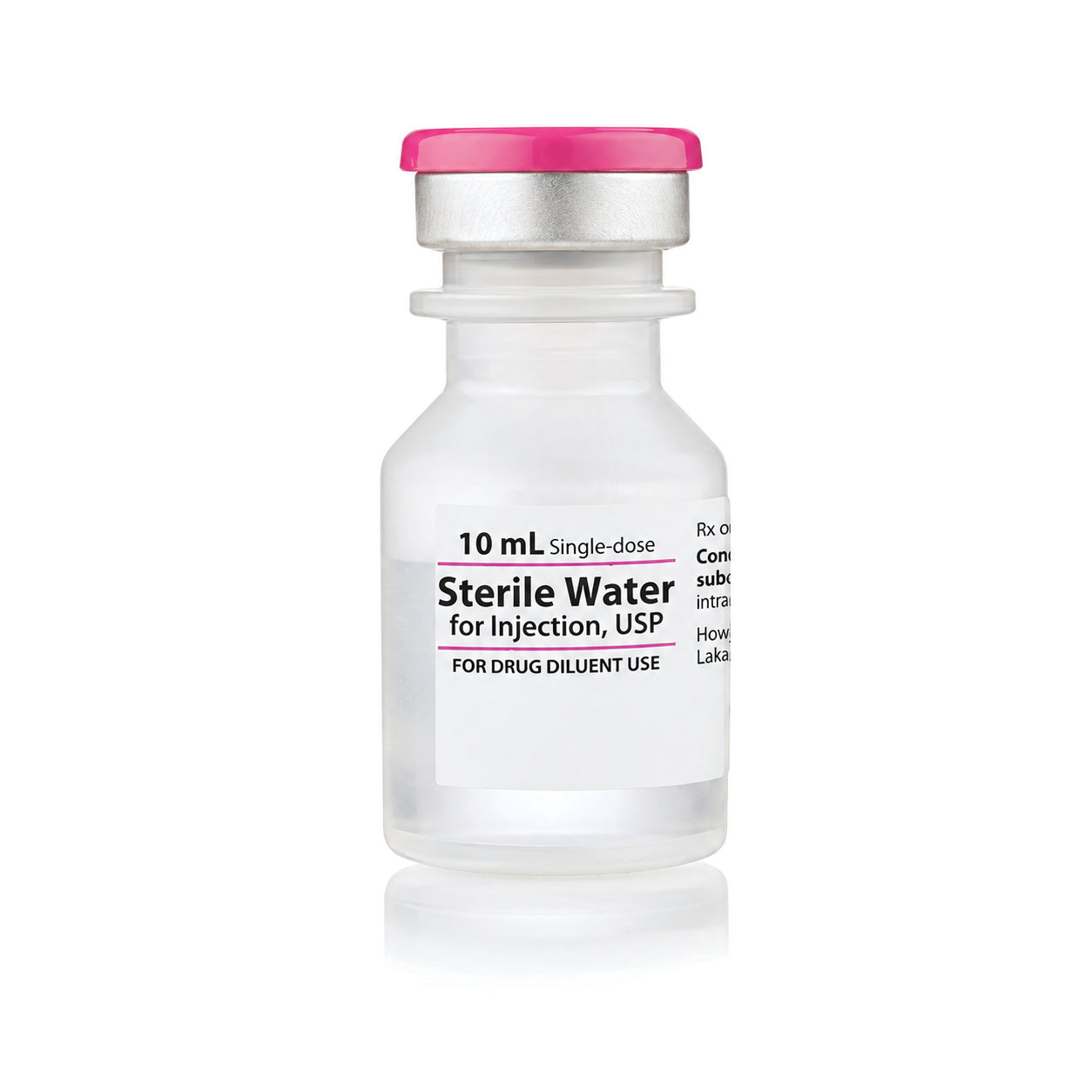
Preservative-free
Sterile Water
for Injection, USP
- Shown
- 10 mL plastic vial
- Preservative
- None
- Container
- Single-dose
Selected Hospira / Pfizer presentations. [1] [2]
Benzyl alcohol helps limit bacterial growth in a multiple-dose vial. It does not protect against viruses or prevent every instance of bacterial contamination. A preserved vial still requires careful handling; the word bacteriostatic is not a guarantee that an opened vial remains sterile. [3]
The referenced Sterile Water for Injection contains no antimicrobial preservative. Its single-dose designation matters even when some water remains: the label instructs users to discard the unused portion rather than retain it for another occasion. [2]
02 / The exact product
Start with the medicine. Then check the vial.
The medicine's prescribing instructions determine the appropriate diluent. Compatibility cannot be inferred from the words water or sterile. A pharmacist can help confirm the exact formulation and presentation for the prescription. [2]
Presentation details matter, too. Hospira's bacteriostatic-water labeling lists a 20 mL fill in a 30 mL glass vial containing 1.1% benzyl alcohol, distinct from the 30 mL plastic vial with 0.9% shown here. The product family name does not tell you the fill volume or preservative concentration. [4]
Two important limits
Benzyl-alcohol-containing bacteriostatic water must not be used in newborns. Both water labels require an approximately isotonic final preparation; plain water given intravenously can damage red blood cells (hemolysis). These products are diluents, not standalone injections. [1] [2]
03 / After opening
Two separate storage questions.
When asking about storage, be specific: are you discussing the opened water vial or the medicine after preparation? Keeping those questions separate makes the answer much clearer.
The opened diluent vial
For an opened multiple-dose vial, CDC cites a 28-day discard period unless the manufacturer specifies a different opened-vial date. That date cannot extend beyond the original expiration date. Suspected contamination requires discarding the vial sooner. [3]
The prepared medicine
That guidance does not establish a 28-day storage period for a medicine mixed with the diluent. The prepared medicine has its own instructions. Both water labels direct prompt use and say not to store reconstituted medicines unless the medicine's manufacturer directs otherwise. [1] [2]
04 / A useful conversation
Know what to confirm before choosing a diluent.
Take the medicine's name and the complete diluent label to your clinician or pharmacist. A clear photograph of the label can make it easier to discuss the exact product instead of relying on a shorthand name. Ask:
- Which exact diluent does my medicine require?
- Does the preservative affect its suitability for my prescription?
- Which vial presentation should I look for?
- What dates and storage instructions apply to the diluent and to the prepared medicine?
05 / Common questions
The details people often ask about.
Is bacteriostatic water also sterile?
Yes. The referenced Bacteriostatic Water for Injection is a sterile preparation containing a preservative. Sterile and preservative-free describe different properties; they are not opposing product categories. [1]
Can I identify the right water by its cap color?
Not reliably. Pfizer lists a garnet cap for both the 30 mL bacteriostatic-water vial and the 10 mL sterile-water vial shown here. Confirm the full product name, ingredients, volume and container designation on the label. [5] [6]
Is preservative-free water always the better choice?
There is no universal winner. The medicine, the patient and the labeled instructions determine the appropriate diluent. Preservative-free does not mean interchangeable with a prescribed bacteriostatic formulation, and adding a preservative does not make a diluent suitable for every medicine. [1] [2]
Original references
Sources behind this guide.
This guide covers the specific U.S. injection-product references shown above. Follow the labeling for the exact medicine and diluent prescribed.
- Pfizer Medical: Bacteriostatic Water for Injection (opens a new tab)
U.S. Hospira prescribing information; formulation, compatibility and warnings.
- Pfizer Medical: Sterile Water for Injection (opens a new tab)
U.S. Hospira prescribing information, revised March 2026; formulation, single-dose designation and handling.
- CDC: Preventing Unsafe Injection Practices (opens a new tab)
Preservative limitations, single-dose use and opened multiple-dose vial guidance.
- DailyMed: Hospira Bacteriostatic Water labeling (opens a new tab)
Distinct labeled fill volumes and preservative concentrations.
- Pfizer Hospital: 30 mL bacteriostatic-water vial (opens a new tab)
Reference presentation and cap color; NDC 0409-3977-03.
- Pfizer Hospital: 10 mL sterile-water vial (opens a new tab)
Reference presentation and cap color; NDC 0409-4887-10.